Beyond 100%: Mastering Uptime in Modern Bitcoin Mining
Published
16.2.2026
How system and hashing uptime metrics reveal the true health of your mining operation.

Table of Contents
In the competitive world of Bitcoin mining, profitability is often a game of margins. While most miners focus heavily on their total hashrate, there is a silent metric that determines whether that hashrate actually translates into revenue: Uptime.
At its core, Bitcoin mining is the business of converting electricity and time into hashes. However, uptime is rarely a binary metric. A miner might appear online while producing zero hashes because of a firmware crash, pool error, or thermal throttling. This is why distinguishing between connectivity uptime and hashing uptime is critical. The gap between the two reveals the true health of an operation. It can highlight lost revenue from technical glitches and network instability, or it can confirm that a fleet is successfully participating in demand response programs by curtailing when it is more profitable to stay dark. Ultimately, managing that gap is the primary challenge of optimization.
As the mining industry integrates more deeply with energy grids and faces harsher environmental challenges, the definition of "success" is shifting from raw runtime to Optimized Uptime.
The Strategic Balance: Why More Uptime Isn't Always Better
Historically, a miner’s goal was simple: keep the machines running 24/7. Today, sophisticated operations use Curtailment as a strategic tool. Mining profitability is a function of Miner Efficiency (J/TH), Hashprice, and Energy Price. When energy costs spike, it may be more economical to pause operations.
Common reasons for purposeful downtime include:
- Peak Energy Price Avoidance: Shutting down when the cost to produce a hash exceeds its value.
- Coincident Peak Avoidance: Reducing load to avoid massive transmission charges.
- Grid Demand Response: Participating in programs that pay miners to stay offline during grid stress.
- Thermal Protection: Historically, miners used a "hard shut down" feature to prevent hashboards from burning out when overheating.
The Innovation of Dynamic Performance Scaling (DPS)
Traditionally, miners used a "hard shut down" to prevent hashboards from burning out when overheating. To combat this without losing 100% of production, Braiins introduced Dynamic Performance Scaling (DPS) in June 2020. Instead of a complete shutdown when temperatures rise, DPS iteratively downclocks the miner to a stable temperature. Once environmental conditions improve, it scales back up. This ensures you keep mining, even at a lower rate, rather than suffering total downtime. This pioneering feature has since become an industry standard that many other firmware providers have emulated.
Energy Intelligence: The Modern Solution for Energy Markets
While DPS handles environmental challenges at the device level, Braiins Manager provides the "Energy Intelligence" needed for modern market challenges at the global operations level. To remain profitable today, miners must actively participate in energy markets through:
- Strike Price Curtailment: Automatically pausing miners when electricity spot prices exceed your profitability threshold.
- CSP Integrations: You can avoid peak energy prices and peak demands to defend your mining economy. You can also participate in demand response programs, and Braiins Manager will make sure it delivers the needed load every time.
- Controlflow Scheduled Curtailment: Automating pauses and resumes based on specific schedules or complex operational logic. This is highly suitable for providers on tariff energy pricing.
.jpg)
Visualizing Uptime Metrics in Braiins Manager
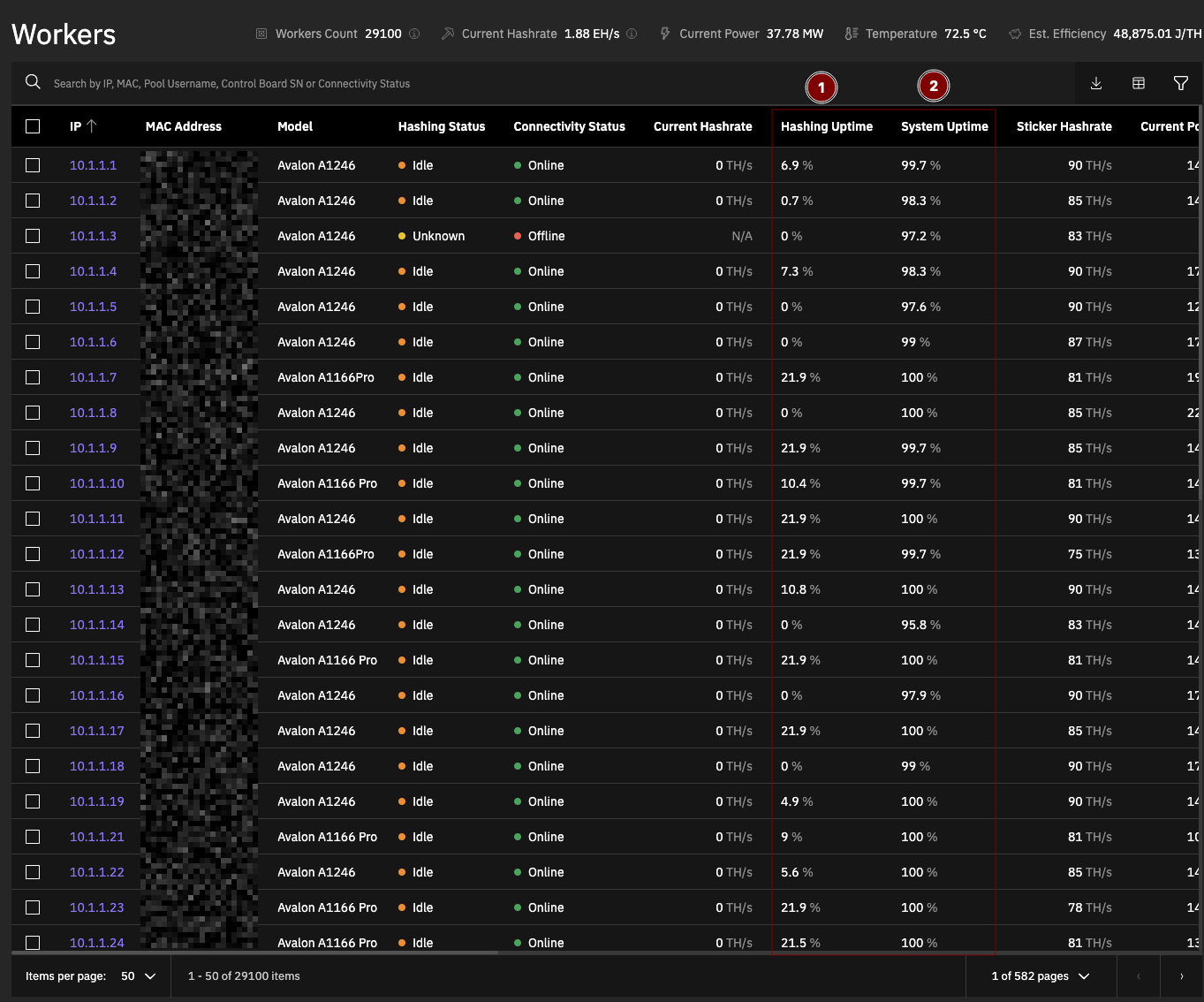
To help miners navigate this landscape, Braiins Manager provides high-granularity uptime tracking. These metrics are filter-aware, allowing you to analyze performance by specific locations, providers, or custom worker groups.
Here is how Braiins Manager calculates the two vital layers of your operation's health:
1. Worker System Uptime (Connectivity-Level)
This measures basic connectivity. It answers the question: "Is the miner reachable by the network?"
- The Calculation: It is the percentage of time intervals where the miner was online and responsive, regardless of whether it was actually hashing.
- Why it matters: This helps identify networking issues or power supply failures that are unrelated to the mining software itself.
2. Worker Hashing Uptime (Hashing-Level)
This is the "classic" uptime metric. It answers: "Is the miner actually doing work?"
- The Calculation: The percentage of time intervals where the miner’s hashrate was greater than zero.
- Why it matters: A miner can be "System Online" but not hashing due to a firmware crash, pool connection error, overheating, or curtailment.
Take Control of Your Fleet
Whether you are managing thermal limits with DPS or navigating volatile energy markets with Energy Intelligence features, Braiins Manager gives you the analytical depth to see exactly how effectively your hardware is being utilized, along with advanced management tools to act on those insights in real time. These metrics are fundamental for understanding system health and ensuring your operation remains profitable in any market condition.
Connect with the Braiins team and other miners to share uptime optimization strategies, learn how operators are navigating energy markets, and stay ahead of new features. Join our Telegram community.
Categories
Be the first to know!


Most Recent Articles
Hashing in 7 Days While the Miners Ship: How Sazmining Uses Braiins Hashpower Contracts
15.9.2026
Price Adapt: Automated Bitcoin Mining Profitability Optimization with Braiins Manager
20.8.2026
Enel Partnership: Introducing Energy Intelligence - Make Your Flexible Bitcoin Mining Load Pay
16.7.2026