Hashrate Heated House: The Complete Guide to Heating Your Home with Bitcoin Mining
Published
19.3.2026
Adam, a QA engineer at Braiins, heats his entire house with a single hydro-cooled bitcoin miner. The system provides floor heating, hot tap water, and earns bitcoin at the same time. It has been running for over a year.
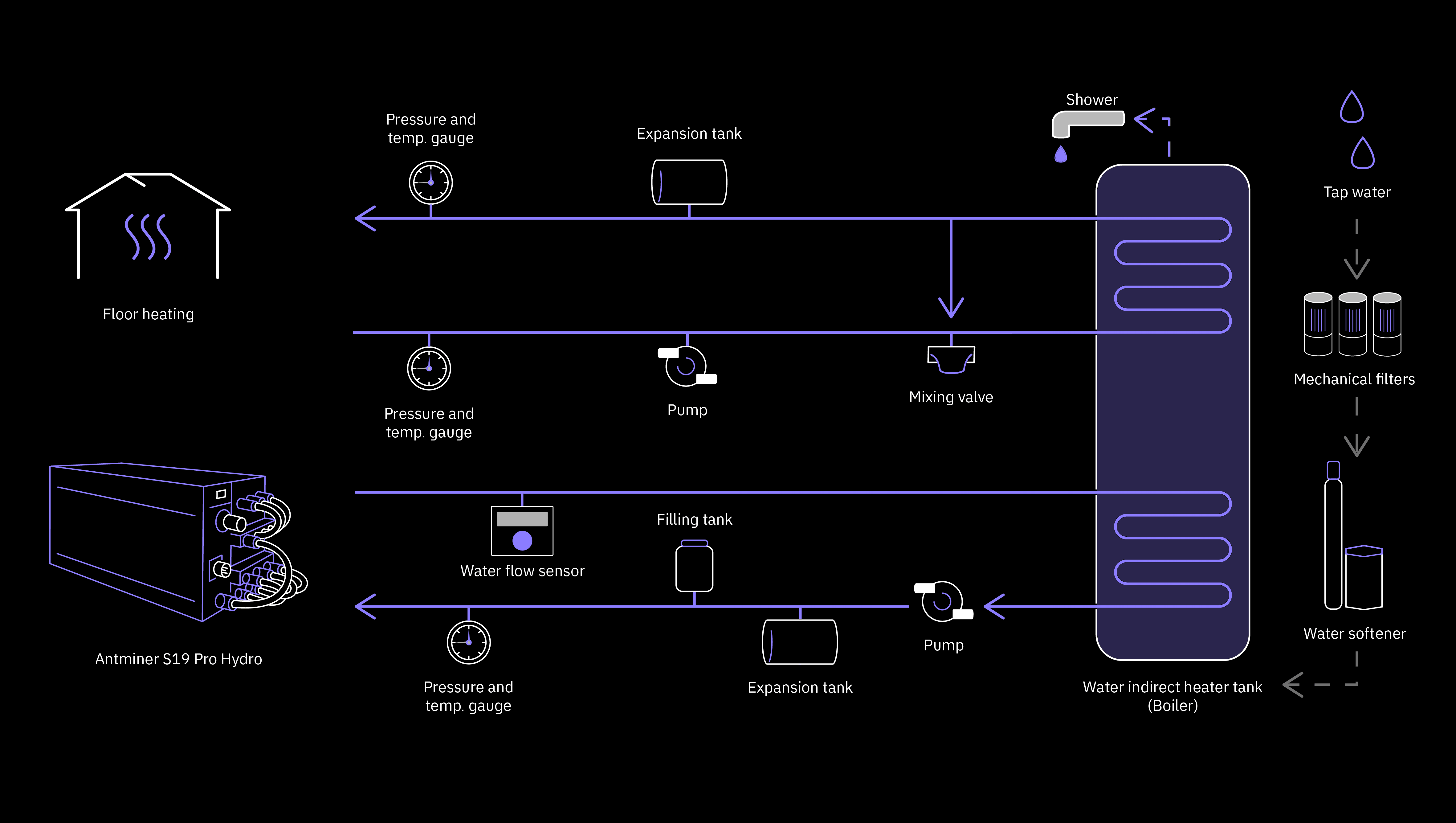
Table of Contents
This post covers the full build: planning, hardware, software, real operating costs, and maintenance. All based on one year of real data.
Who Is Behind This Hashrate Heating Project?
Q: Who are you and what is your background?
I work as a QA engineer at Braiins. I grew up learning from my father, an electrician, which gave me hands-on experience with electrical work from a young age. When I started working at Braiins, I knew that when I build a house, it will be heated by hashrate.
Q: What do you think about bitcoin?
I think and dream only about hashrate.
Q: Why did you decide to build a hashrate heating system?
Heating was the top priority for my new home. I worked with a project engineer to design the house so that mining heat reuse fits into the overall heating concept. The requirements were similar to a heat pump setup: low-temperature floor radiant heating throughout the house. Lower water temperature means better efficiency, whether you use a miner or a heat pump. I built only the miner loop myself. The tap water loop and floor heating were installed by a certified plumber.
Q: What is your view on mining heat reuse and its future?
Hashprice is getting lower and margins are shrinking. Heat reuse will become more important over time. It is sustainable, works well with grid balancing and curtailment strategies, and helps bitcoin mining become more decentralized..
How to Plan a Bitcoin Mining Heating System
Q: What resources did you use during planning?
I researched across forums, Reddit, Twitter, and YouTube. I studied two-phase cooling, immersion cooling, and eventually settled on hydro cooling. I combined general knowledge of thermodynamics and hydrodynamics with what I call "the method of trial and error" and continuous improvement.
Key resources and communities:
- HeatPunks.org and their forum
- CoinHeated on YouTube
- Home Bitcoin Immersion Mining on YouTube
- Chinese hydro cooling manufacturers and their documentation
- Russian and Indian YouTube channels covering DIY cooling setups
Q: Did you consult with professionals?
Most of the research was self-directed through forums and social media groups. I occasionally consulted a plumber, but most of the knowledge came from online communities.
Q: Why did you create detailed schematics?
People kept asking about the system. The schematic helps others who want to build something similar. I used SmartDraw and Google Drawings to create the plans. You can download the updated and complete schematics in full quality.
Q: What went well and what would you improve in the planning phase?
I had enough time to fix errors along the way. The trickiest part was sizing the pump. High-head pumps are noisy, while home circulation pumps are quiet but not powerful enough. The biggest success was correctly sizing the boiler tank and the heat exchangers inside it. The electrical installation was straightforward from the start. In Europe, access to three-phase electricity is standard, which makes projects like this easier.
Q: Any tips for someone starting their own hashrate heating project?
- Read the book on heat reuse. Get the knowledge foundation first.
- Know your heating power needs up front. It is difficult to resize the heating capacity later.
- Consider the form factor. If a shoebox-style miner fits your space, use it.
- Avoid immersion oil in your living space. Hydro cooling is cleaner and easier to maintain.
- Use pressure relief valves and expansion tanks. Safety first.
Hardware: How the 3-Loop Hashrate Heating System Works
The system uses three separate loops. Each loop handles a different temperature range and serves a specific purpose.
Loop 1: The Miner Loop (Hottest)
This loop extracts heat from the bitcoin miner and moves it into the boiler.
How it works:
- Coolant: Propylene glycol mixed with demineralized water and inhibitors
- Tubing: Hard PTFE tubes (thermally and chemically resistant)
- Temperature range: Inlet 25-50°C (lower is better for efficiency), outlet up to 65°C
- Type: Closed loop with a separate circulation pump
Note on temperature: Bitmain documentation lists maximum inlet temperature as 45°C. With DPS (Dynamic Power Scaling) in Braiins OS, the miner can run at lower power, which allows higher inlet temperatures while staying safe.
Components:
- Bitcoin miner (hydro-cooled)
- Water flow sensor
- Temperature sensor
- Pressure sensor
- Circulation pump
- Tubes and plumbing fittings
- Filling tank
- Expansion (buffer) tank
- Heat exchanger (inside the boiler)
- Power meter switch
- Pressure relief valve
Loop 2: City/Tap Water Loop (Medium Temperature)
This loop sits between the miner and the home heating. It is not common in traditional home water heating, but it is essential for this system.
How it works:
- Type: Open loop (connected to city water supply)
- Temperature range: Cold water enters at around 10°C and can be heated up to 60-65°C
- Water treatment: Mechanical filter, charcoal filter, and water softener
- 60-65°C is hot enough to kill Legionella bacteria, making the water safe for domestic use
Components:
- Smart water flow valve
- Filters (mechanical, UVC, softener)
- Boiler (accumulation tank / indirect water heater): Bottom exchanger: 1.5 m² heat exchange surface, enough for one miner at recommended water flow rates. Top exchanger: 1.0 m² heat exchange surface, transfers heat to the floor heating loop.
- Expansion (buffer) tank
- Pressure relief valve
Loop 3: Floor Radiant Heating Loop (Lowest Temperature)
This loop heats the rooms.
How it works:
- Coolant: Demineralized water with inhibitors and biocides
- Type: Closed loop with a separate smart pump
- Temperature range: Mixed to around 35°C going to the floor, returns at around 20°C
- Control: A mixing valve blends hot water from the boiler with cooler return water from the floor
Components:
- Heat exchanger (inside the boiler)
- Smart circulation pump
- Pressure sensor and temperature sensor
- Mixing valve with thermostat
- Floor heating distribution manifold
- Floor heating actuators (one per zone)
- Room thermostats
- Shutoff valves
- Piping, drain, and filling port
- Pressure relief valve
How the Controls Work
The system is largely self-regulating:
- DPS in Braiins OS monitors boiler temperature. When the bottom sensor reads 60°C, the miner reduces power. When someone uses hot water, cold water flows in, the temperature drops, and the miner ramps back up.
- Room thermostats control floor heating. Each room has a thermostat connected to an actuator on the floor heating manifold. When heating is needed, the valve opens.
- The smart pump adjusts automatically. It monitors pressure and adjusts speed based on how many valves are open. When all valves are closed, the pump slows down on its own.
Q: Are all components mandatory?
No. All sensors are optional but recommended for troubleshooting and monitoring. The silent pump is optional depending on your space. The city water filtration system is mandatory. Room thermostats and actuators are sized to your specific house and needs.
Q: Why include the optional components?
Better troubleshooting, detailed monitoring graphs in Home Assistant, longer system life, and comfort. In my case, the entire technical room is located behind the kitchen, so keeping noise low was a priority.
Q: Would you change anything after one year?
- More efficient miner. This is the biggest upgrade (moving to S21).
- Bigger boiler. More liters means more hot water storage and better efficiency.
- More shutoff valves for easier maintenance.
- More sensors and flow meters integrated directly into Home Assistant.
- Better tube insulation. Uninsulated tubes heat the technical room instead of the water. I partially insulated the tubes and plan to finish it next year.
- The expansion tank and filling tank have to be in front of the pump, not behind. It's a plumber's code.
Software: What Runs a Hashrate Heating System
The software stack is simple:
- Braiins OS: The mining firmware. The most critical piece of the system.
- Home Assistant (HASS): Dashboard and automation platform for monitoring and control. Uses the hass-miner integration.
- Netbird or Tailscale: VPN for remote access to the local network from anywhere.
Why Braiins OS Is Essential for Mining Heat Reuse
DPS (Dynamic Power Scaling) is the feature that makes this system work. Without it, you would need manual control or external automation to match mining power to heating demand.
With DPS:
- The miner automatically adjusts its power output based on water temperature
- When the boiler is full of hot water, the miner scales down
- When hot water is used and cold water flows in, the miner scales back up
- No manual intervention needed
Q: What mining software do you recommend for a project like this?
Braiins OS only! Combined with Home Assistant and the hass-miner integration, you get full visibility and control over the entire system.
The Real Numbers: How Much Does a Hashrate Heating System Cost?
Adam ran this system for a full year. Below is a comparison of three heating options based on real data (will change based on location, local suppliers, government subsidies available and other factors).
Type of house: Adam’s modern timber frame construction features a wall assembly consisting of gypsum fiberboard (Fermacell), a vapor barrier for a diffusion-closed system, KVH structural timber studs with rigid mineral wool insulation, and an external layer of EPS (polystyrene) for thermal efficiency.
Upfront Costs (Capex)
Option 1: Heat pump
- Heat pump unit: $10,000 - $15,000
- Plus ongoing maintenance costs
Option 2: Electric boiler (water resistive heating)
- Electric boiler: $1,000 - $2,000
- Floor resistive or foil heating (separate from hot water): $5,000 - $7,000
Option 3: Bitcoin miner (hashrate heating)
- S19-series miner: $500 - $1,500
- S21-series miner: $2,500 - $8,000
All three options (except floor resistive) need a boiler / accumulation tank ($1,000 in Adam's case) plus plumbing parts (up to $500). This cost is roughly the same regardless of heating method. Floor radiant heating (not included in costs) is also the same for all options. Adam assumes it comes with the price of a house rather than heating system choice.
Annual Operating Costs (Opex)
Adam’s house: calculated thermal loss of 3.5 kW at -10°C ambient temperature, heating season of 4.5 months.
Assumptions:
- Electricity cost: $0.22/kWh
- Annual heating consumption: 4.5 MWh
- Average hashprice for 2025: 50 sats/TH/s
- BTC price: $100,000
- Target room temperature: 23°C
- Yearly average ambient temperature 10°C at this location (all seasons)
Miner / Electric boiler:
- Annual electricity cost: $990
- Annual maintenance: $0
- Total annual cost: $990
Heat pump (COP 3, Coefficient of Performance):
- Annual electricity cost: $330
- Annual maintenance: $175
- Total annual cost: $505
Bitcoin income from mining during heating:
- S19-series (30 J/TH): ~0.003125 BTC = $312/year (31.5% cash back on electricity)
- S21-series (15 J/TH): ~0.00625 BTC = $624/year (63% cash back on electricity)
Without pump power costs, those numbers reach 35.5% and 70.9%.
Heat Pump Payback
A heat pump saves about $485/year in electricity compared to an electric boiler, but costs $10,000 - $15,000 more upfront. Payback period: 24 years. ROI: 4%.
There is another factor: heat pump efficiency varies with target temperature. Floor heating at 35°C runs at a COP (Coefficient of Performance) of 4. Heating water to 65°C for showers (needed to prevent Legionella bacteria) drops the COP to around 2.5. This lowers the real-world average efficiency.
A hashrate heating system runs at similar efficiency regardless of outside temperature or target water temperature.
Maintenance: Is a Hashrate Heating System Difficult to Run?
Q: What needs maintenance and how often?
Almost nothing. If you use propylene glycol in the miner loop, there is no regular maintenance needed. Due to the lower operating temperatures, calcium buildup in the boiler is minimal with the right grounding.
Q: Is it a pain to operate? How technical is it?
It is a pleasure to think technical about a dream machine. It is a pain to sort this up on paper and write a blog post. For people like me, it is called nerds.
The system is self-regulating once set up. DPS handles miner power, the smart pump handles floor heating pressure, and thermostats handle room temperatures. Day-to-day, there is very little to do.
Adam’s Future Hashrate Heating Projects
Upgrading to S21-Series Miners
More efficient miners improve the economics. As new hardware arrives and older models drop in price, the numbers get better. The electricity is already spent on heating, so every sat earned is additional income.
Hash-Heated Sauna
Adam’s next project is a sauna pre-heated by bitcoin miners.
The S21-series miners can monitor temperature in each chip individually, making it safe to run at higher air output temperatures than the S19-series. The plan:
- Miners pre-heat the sauna from 10°C up to 65-70°C.
- A traditional electric stove handles only the last stretch to 90°C+.
- Most of the energy comes from mining. Electricity is only needed for the final temperature push.
He also plans to attend the Heatpunk Summit in Denver to connect with other builders in the mining heat reuse community.
Questions about building your own system?
Reach out to Adam on X: https://x.com/AdamKrizka21
Get our custom mining firmware to optimize your ASIC machines.
Categories
Be the first to know!


More from
Mining Use Cases
Most Recent Articles
.png)
20.10.2026
Hashing in 7 Days While the Miners Ship: How Sazmining Uses Braiins Hashpower Contracts
15.9.2026
Price Adapt: Automated Bitcoin Mining Profitability Optimization with Braiins Manager
20.8.2026